
How the Abraham Accords could be key to protecting Americans' medicine cabinets
The U.S. Israel Education Association has released a report arguing that Abraham Accords could cut America's reliance on China in the pharmaceutical space.
EXCLUSIVE: The threat from China may be closer to home than most Americans realize — sitting in their bathroom cabinets. A new report warns that the U.S.'s dependence on Chinese-made drugs leaves the country vulnerable and points to a possible fix: friend-shoring, or learning to rely on allies rather than adversaries.
The U.S. Israel Education Association (USIEA) recently released a report warning that "foreign nations are holding America’s medicine cabinets for ransom." This includes China, which plays a key role in the U.S. medical supply chain as 41% of Key Sourcing Materials (KSMs) used in U.S.-approved active pharmaceutical ingredients (APIs) are sole sourced from China.
Additionally, the report notes that "China is the sole supplier of at least one KSM for 679 APIs, accounting for 37% of all APIs," which puts the American consumer at serious risk. USIEA argues that the current U.S. medical supply chain puts price before safety and the equivalent of "playing Russian Roulette" with bad actors.
SUPPLY CHAIN AI COMPANY SOUNDS THE ALARM OVER AMERICA'S RELIANCE ON CHINESE-MADE PHARMACEUTICALS
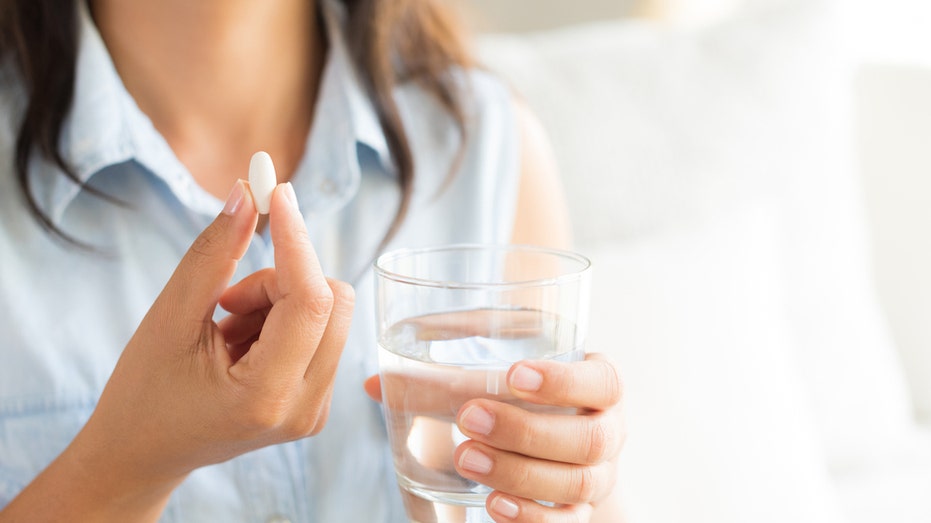
The U.S. Israel Education Association (USIEA) recently released a report warning that "foreign nations are holding America’s medicine cabinets for ransom." (iStock)
"About 90-plus percent of the pharmaceuticals, for example, that we use here in the United States by volume are generic drugs, and they are overwhelmingly produced overseas, largely out of China and India. And if China decided one day to simply stop sending us pharmaceutical products because of political reasons... we'd be in very tough straits because we really would not have the pharmaceutical products we need to save people's lives," former FDA Associate Commissioner and USIEA Senior Fellow Peter Pitts told Fox Business.
The USIEA report points to the COVID-19 pandemic as a prime example of the vulnerabilities in the U.S. pharmaceutical supply chain and how its reliance on China could become dangerous. During the pandemic, the U.S. experienced a shortage of contrast agent, which is what medical professionals use to improve visibility of organs, blood vessels and tissues in X-rays, CT scans and MRIs. The report notes that in 2022, a large contrast agent manufacturing facility near Shanghai shut down due to a COVID lockdown, causing chaos in the U.S.
"Here at home, this resulted in radical decreases in angiograms, perfusion scans and other tests crucial for stroke assessments, cancer diagnoses, and other urgent medical care," the report reads. "This one plant in China provides almost all the contrast agent used in the United States. It’s not hard to imagine similar supply chain crises for diabetes test strips or ADHD medications, or penicillin driven by geopolitical purposes."
The issue, however, predates the pandemic. The USIEA report references an instance in 2008 when a substandard anticoagulant from China killed 81 people and left 785 severely injured.
The FDA’s insight into Chinese production is also limited and heavily controlled, making for what the USIEA deems a "recipe for disaster."
As the report explains, when inspectors are required to notify a facility ahead of time, "manufacturing logs get altered, factory floors get cleaned, expired supplies get moved, and access to many key areas get restricted."
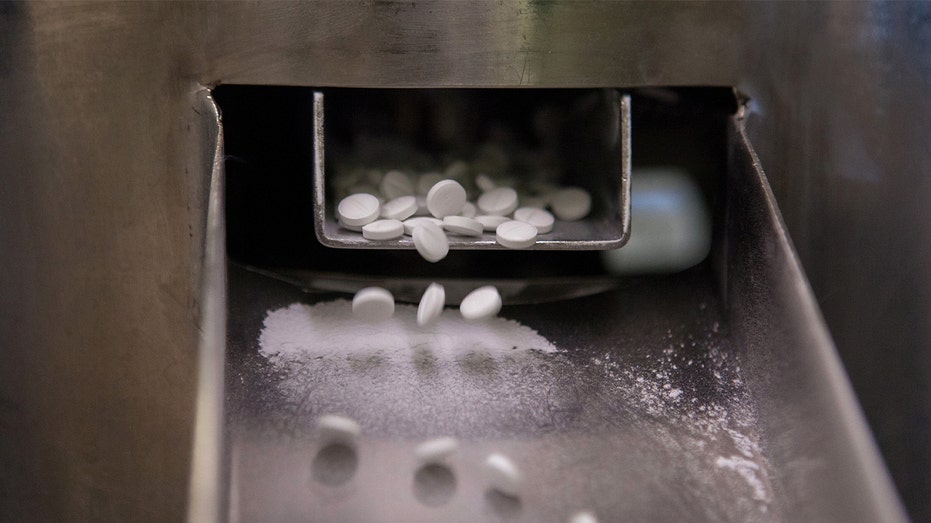
Torasemid AL high blood pressure tablets exit a Fette Compacting 2090i machine, manufactured by Fette GmbH, at the Stada Arzneimittel AG pharmaceutical factory in Bad Vilbel, Germany, in 2014. (Krisztian Bocsi/Bloomberg)
TRUMP SENIOR COUNSELOR SAYS NEW TARIFFS DESIGNED TO END CHINA’S GRIP ON US SUPPLY CHAIN
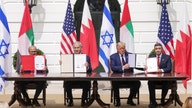
The organization put forward a solution that has already gotten some traction in Washington — the establishment of an FDA Abraham Accords Office. The report describes the office as a "regional regulatory mission" that would act as "a forward-deployed extension of the FDA" with three major priorities: economic security, public health and diplomatic leadership.
The purpose of the FDA Abraham Accords Office, according to the report, would be "to institutionalize friend-shoring, enabling the U.S. to diversify supply chains for essential medicines through trusted partners while maintaining the FDA’s 'gold standard' for oversight." This would allow the U.S. to shift its reliance from riskier nations, such as China, to friendlier ones, such as Israel, the United Arab Emirates, Bahrain and Morocco.
A bipartisan bill that has already passed in the House has a provision for creating the FDA Abraham Accords Office. The bill, known as H.R.1262, or the "Mikaela Naylon Give Kids a Chance Act," was introduced by Rep. Michael McCaul, R-Texas, in February and has co-sponsors from both parties. According to the legislation, the office would not be approving drugs, rather it would work as a coordinator between the FDA and manufacturers in the Abraham Accords nations.
The USIEA argues that the Abraham Accords nations can be "trusted partners who share regulatory standards and political alignment."
"The Abraham Accords countries have made a decision that they are looking to the 21st century... So, it's provided this opportunity to expand into an area of the world that, quite frankly, the United States, especially in this space, had largely ignored," USIEA Director of Policy and Strategic Operations EJ Kimball told Fox Business.
However, the friend-shoring strategy is as practical as it is political, as Kimball, Pitts and the USIEA argue that the Abraham Accords nations are ready to meet the U.S.'s pharmaceutical needs.
"[Israel and the United Arab Emirates] are two very stable entities that are highly advanced in a number of different areas, not the least of which are pharmaceutical development and manufacturing," Pitts said. "They punch well above their weight in these spaces."
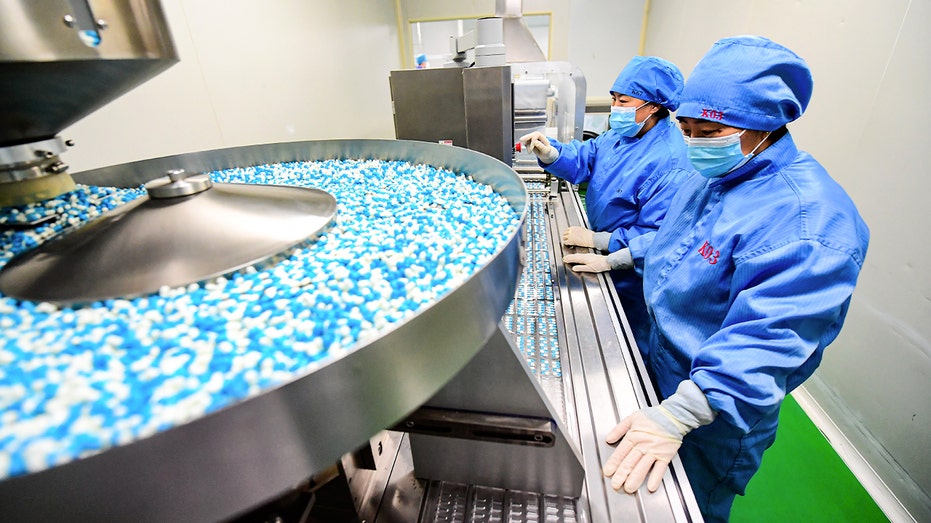
Employees work on the production line of Xiaoqinglong capsules, a cough medicine, at a factory in 2023 in Shenyang, Liaoning Province of China. (VCG via Getty Images)
The push to expand pharmaceutical cooperation with the Abraham Accords nations is about more than securing America's supply chain; it would also allow the U.S. to get ahead of Chinese influence. Kimball warns that China has been hard at work trying to deepen its presence in the Middle East. However, he and Pitts believe that by adding to its Abraham Accords relationships, the U.S. can stop China in its tracks.
"Morocco was very clear to us that they want to work with the United States, and China is knocking on their door. And they do some work with China, but they understand the threat that it poses to them, and so if the United States doesn't come at some point to knock on their door as well, eventually China's going to come in because you can only say 'no' for so long when they're offering so much to you," Kimball said.
Pitts slammed past U.S. administrations for "giving the cold shoulder" to potential international partners without thinking about the consequences. However, he believes that the U.S. can still attract countries that have turned to China.
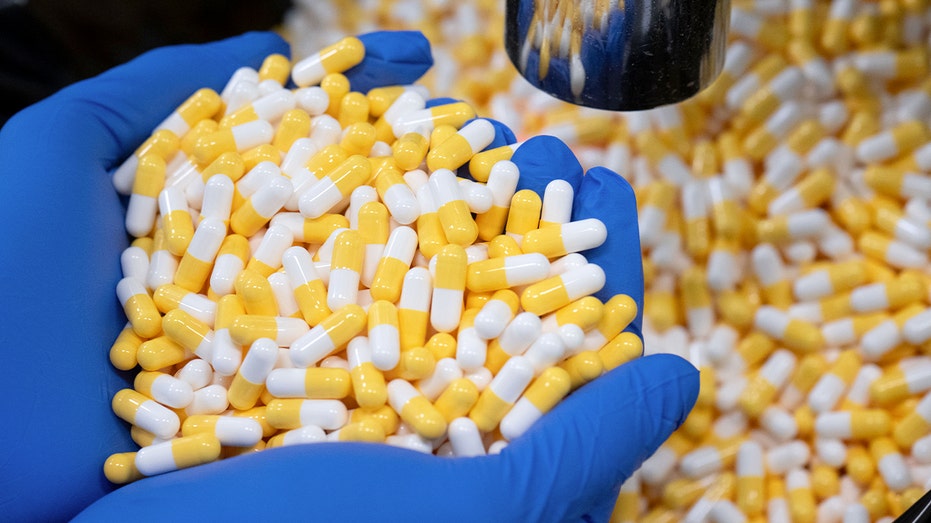
Hard capsules containing the medicine "Grippostad" are produced at the headquarters of the pharmaceutical manufacturer STADA in Bad Vilbel. (Boris Roessler/picture alliance via Getty Images)
GET Gxstocks ON THE GO BY CLICKING HERE
"As soon as we open up our arms and say we want to do business with countries that we trust, with countries that embrace high quality, with countries that don't cheat, with countries that play fair, with countries that recognize the value of technological advancement for reasons other than military and geopolitical posturing, you know, we win hands down every time, and everybody wins," Pitts said.
The USIEA asserts that moving the supply chain to friendlier nations, such as those in the Abraham Accords, is not just a strategic move but an essential act to protect national security. As the report puts it, "In a world where supply disruptions can endanger national stability as much as military threats, ensuring access to essential medicines is an act of sovereignty."